


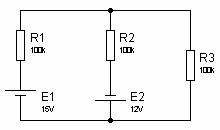
 Exercice 2Utiliser le théorème de superposition pour calculer la tension UAB aux bornes de R1.
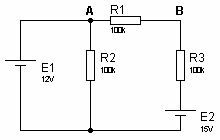 Exercice 3Utiliser le théorème de superposition pour calculer la tension aux bornes de R1.
 Exercice 41. Dessinez le générateur de Thévenin de la figure suivante, sans tenir compte de la résistance R.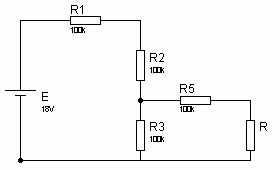
2. pour R = 150 kΩ a. Déterminez le courant qui traverse R b. calculer la puissance fournie à RExercice 5Déterminer les caractéristiques ET et RT du générateur de Thévenin équivalent au circuit suivant, sans tenir compte de la résistance R.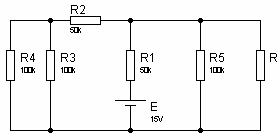 Exercice 6Dans le montage suivant, déterminer le courant I circulant dans la résistance R = 100k.
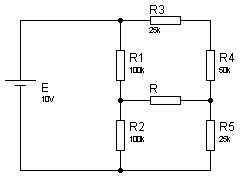 Exercice 71. Dessinez le générateur de Thévenin de la figure suivante, sans tenir compte de la résistance R.
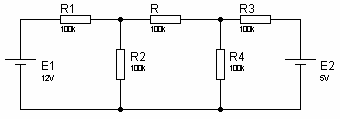 2. Calculez la tension UR et la puissance fournie à la résistance R.Exercice 8Dessinez le générateur de Thévenin de la figure suivante, sans tenir compte de la résistance R.
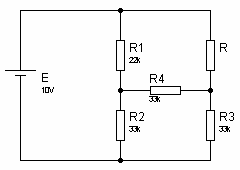 ------------------------------------------------------------------------------------------------
CORRECTION - SOLUTIONS
------------------------------------------------------------------------------------------------Solution Exercice 1
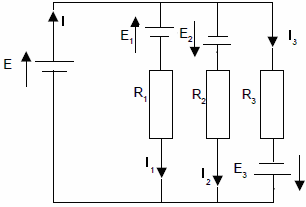
Pour calculer le courant qui circule dans R3, on calcule la tension aux bornes de R3.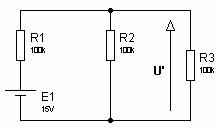 fig1
fig1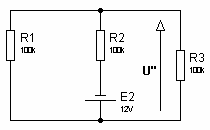 fig21- on calcule la tension U’ (aux bornes de R3) avec E2 en court-circuit (fig1)U’ = E1 x (R2 // R3) / [(R2 // R3) + R1] = 15V x 50 / 150 = 5V2- on calcule la tension U’’ (aux bornes de R3) avec E1 en court-circuit (fig2)U’’ = -E2 x (R1 // R3) / [(R1 // R3) + R2] = -12V x 50 / 150 = -4V3- la tension U aux bornes de R3 est : U = U’ + U’’ = 1V4- I = U / R3 = 1V / 100k = 10μA
Solution Exercice 2
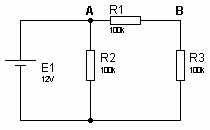 fig3
fig3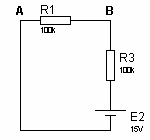 fig4
fig41- on calcule la tension U’AB avec E2 en court-circuit (fig3)U’AB = E1 x R1 / [R3 + R1] = 12V x 100 / 200 = 6V2- on calcule la tension U’’AB avec E1 en court-circuit (fig4)U’’AB = - U’’BA = -E2 x R1 / [R1 + R3] = -15V x 100 / 200 = -7,5V3- UAB = U’AB + U’’AB = 6V – 7,5V = 1,5V
Solution Exercice 3
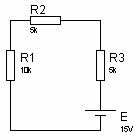 fig5
fig5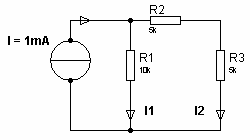 fig6
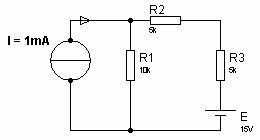
fig61- on calcule la tension U’ avec le générateur de courant ouvert (fig5)U’ = E1 x R1 / [R1 + R2 + R3] = 15V x 10 / 20 = 7,5V2- on calcule la tension U’’ avec E en court-circuit (fig6)U’’ = I1 x R1 = I2 x (R2 + R3) = I x R1 // (R2 + R3) = 1mA x 10 x 10 / (10 +10) = 5V3- U = U’ + U’’ = 7,5V + 5V = 12,5V
Solution Exercice 4
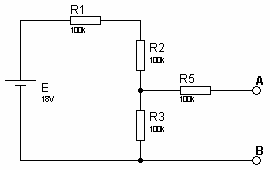 fig7
fig7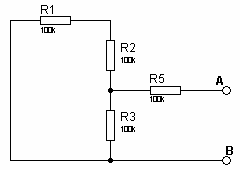 fig8
fig81. Eth = UAB = E x R3 / ( R1 + R2 + R3) = 18 x 100 / (100 + 100 + 100) = 6VRth = RAB = R5 + R3 // (R2 + R1) = 100k + 100k x 200k / 300k = 166,67k2. pour R = 150 kΩ
 a. I = Eth / (Rth + R) = 18,95μAb. P = R x I2 = 53,85μW
Solution Exercice 5
1. on calcule Eth = UAB
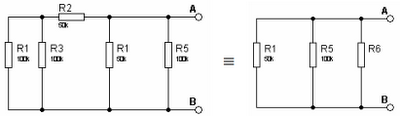 R6 = R2 + R3 // R4 = 50k +100k //100k = 100kEth = UAB = E x (R5 // R6) / [R1 + (R5 // R6)] = 15V x 50k / 100k = 7,5V2. on calcule Rth = RAB
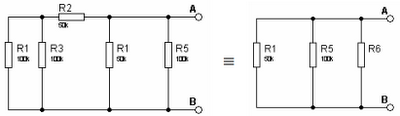 Rth = RAB = R1 // R5 // R6 = 25k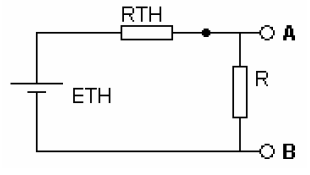
Solution Exercice 6
1. on calcule Eth = UAB et Rth = RAB
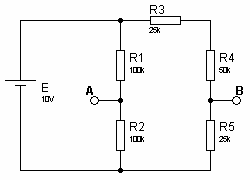 Eth = UAB = UA - UBUA = E x R2 / (R1 +R2) = 10V x 100 / 200 = 5VUB = E x R5 / ( R3 + R4 + R5)UB = 10V x 25 / 100 = 2,5VEth = UAB = UA - UB = 5V – 2,5V = 2,5V
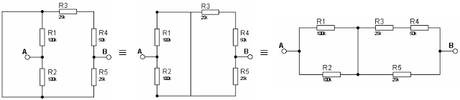 Rth = RAB = (R1 // R2) + [R5 // (R3+R4)] = 100k // 100k + 25k // 75k = 50k + 18,75k = 68,75k2. pour R = 100 kI = Eth / (Rth + R) = 2,5V / (68,75k + 100k) = 14,81μA
Solution Exercice 7
1. on calcule Eth = UAB et Rth = RAB
 Eth = UAB = UA - UBUA = E1 x R2 / (R1 +R2) = 12V x 100 / 200 = 6VUB = E2 x R4 / (R3 + R4) = 5V x 100 / 200 = 2,5VEth = UAB = UA - UB = 6V – 2,5V = 3,5VRth = RAB = (R1 //R2) + (R3 // R4) = 100k // 100k +100k // 100k = 100k2. UR = Eth x R / (Rth + R) = 3,5V x 100k / (100k + 100k) = 1,75VPR = UR2 / R = (1,75V) 2 / 100k = 30,625μW
Solution Exercice 8
1. on calcule Eth = UAB
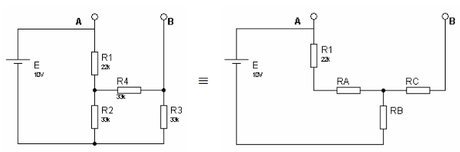 On utilise la transformation triangle-étoile. Puisque R2 = R3 = R4 = 33k, RA = RB = RC = 33k / 3 = 11kEth = UAB = E x (R1 + RA) / (R1 + RA + RB) = 10V x (22k + 11k) / (22k + 11k +11k) = 7,5V2. on calcule Rth = RAB
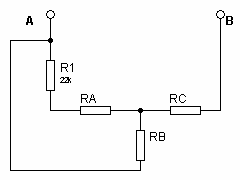 Rth = RAB = [(R1 + RA) // RB] + RC = 33k // 11k + 11k = 19,25k3.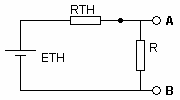







 Jeu de briques
 Snake
Snake Pacman
 Bubble